
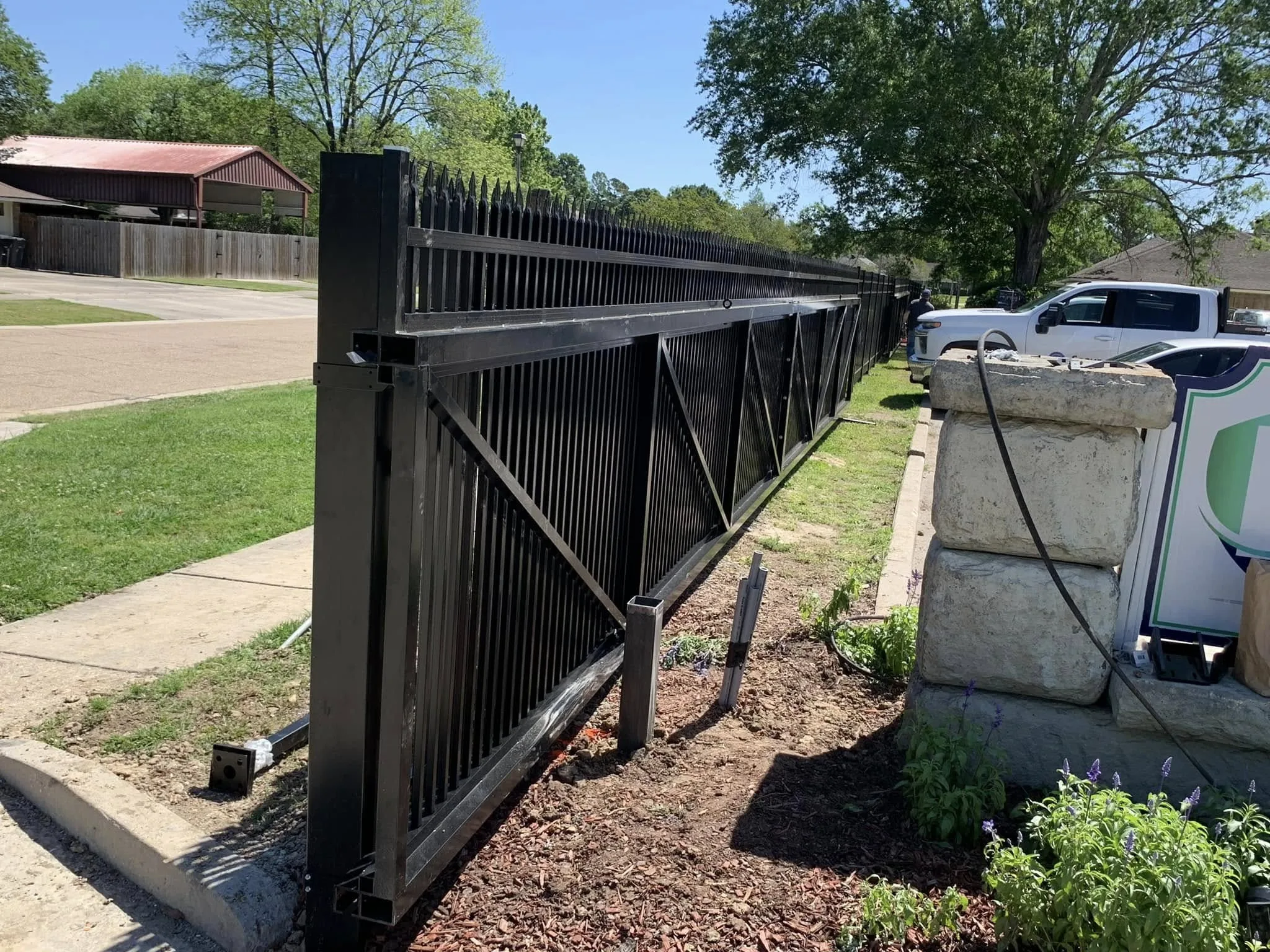
An automated gate on a flood-prone Baton Rouge property should be planned around expected water exposure, drainage, site elevation, electrical-component placement, gate movement, and reliable access—not simply the gate's appearance.
The gate, operator, controls, safety devices, power supply, foundations, and driveway should be considered as one system. Raising one component does not automatically make the entire installation flood-resistant if other parts remain exposed to water, debris, unstable ground, or power loss.
A useful planning relationship is:
flood exposure + site elevation + drainage + gate movement + electrical equipment + access requirements = appropriate automated gate design
For Baton Rouge properties where heavy rain or temporary high water is a concern, those conditions should be understood before the gate type, operator location, and access-control layout are finalized.
Start with where water is likely to collect, how the driveway drains, and whether the entrance remains usable during heavy rain.
A gate that works normally in dry conditions may have problems if water, sediment, debris, or saturated ground interferes with moving components or powered equipment.
Important site questions include:
These conditions can influence the gate type, equipment placement, and overall layout.
Powered and low-mounted components generally deserve the most attention because water can affect electrical equipment, sensors, wiring, and gate movement.
The actual vulnerability depends on the equipment, placement, and anticipated exposure.
Components that may require particular attention include:
Weather-rated equipment is not automatically suitable for submersion.
A component may be designed to withstand rain and normal outdoor exposure without being intended to operate after being covered by floodwater.
It may make sense to place a gate operator above an anticipated water-exposure area, but the correct position depends on the property and the equipment.
If the operator would otherwise sit within a known high-water area, its location should be coordinated with gate geometry, foundations, wiring, controls, and manufacturer requirements.
An elevated operator can still depend on lower components.
The system may also include:
Raising one enclosure while leaving other critical components exposed does not make the complete gate system flood-resistant.
Neither swing nor sliding gates are automatically better for every flood-prone property. The better design depends on drainage, available space, driveway slope, debris exposure, operator placement, and how the gate must move.
A swing gate often avoids a ground track across the driveway, while a sliding gate keeps the gate leaf out of the driveway's swing area. Each approach creates different site considerations.
| Planning Factor | Swing Gate | Sliding Gate |
| Ground-level components | Often fewer moving components across the driveway opening | May use rollers, guides, track-related components, or other low-positioned hardware depending on design |
| Debris sensitivity | Debris can interfere with the swing path or ground clearance | Debris can affect the slide path, rollers, guides, or track area |
| Operator placement | Operator may be positioned near gate posts or gate arms | Operator generally requires space beside the opening |
| Space requirements | Needs adequate swing area | Needs sufficient lateral space for gate travel |
| Driveway slope | Grade can affect swing clearance and movement | Grade along the slide path and side-storage area matters |
| Drainage considerations | Water should not collect around posts, operators, or the swing path | Drainage is important along the travel path and operator location |
| Site fit | May suit sites with adequate swing room and manageable grade | May suit sites with enough side space and a clear, stable travel path |
Flood risk should be one part of the decision rather than the only reason to select a gate type.
Driveway drainage can directly affect gate operation because water often collects near the same low points where operators, posts, sensors, or other components may be installed.
If water commonly collects near the driveway entrance, equipment placement and gate movement should be planned around that condition.
Poor drainage may contribute to:
The gate layout and site drainage should work together.
A convenient location visually may not be the best mechanical location if that part of the driveway repeatedly collects runoff.
Yes. Floodwater, branches, leaves, sediment, and other debris can obstruct the gate path or prevent normal operation.
This applies to both swing and sliding systems.
A swing gate needs a clear arc and suitable ground clearance. A sliding gate needs a clear lateral travel path and properly functioning rollers, guides, or track-related components where used.
After high water or heavy debris exposure, the gate system should be inspected before normal operation resumes.
Even if electrical power is available, the gate should not be operated simply because it can move. Floodwater, debris, or unsafe driveway conditions can still make vehicle access hazardous.
Access-control equipment should be positioned according to expected water exposure, user access, wiring requirements, and manufacturer guidance.
Keypads, readers, intercoms, detectors, and other devices may have different environmental limitations than the gate operator.
An automated gate system may include:
Each device should be considered based on its actual location.
A higher-mounted keypad does not protect buried wiring, vehicle-detection equipment, or other ground-level components connected to the system.
Electrical equipment should be coordinated with anticipated site conditions and installed according to manufacturer instructions and applicable electrical requirements.
Critical powered components should not be placed in predictable water-exposure areas where a more suitable location is available.
Planning may include:
Any required line-voltage electrical work should be handled by a qualified or licensed electrical professional according to applicable requirements.
Flood-prone properties also make coordination between gate equipment, access control, and electrical work particularly important.
The gate may stop operating normally unless the system has compatible backup power or a manual-release method.
Those two features solve different problems and should not be treated as one generic backup system.
Battery backup may provide temporary powered gate operation during some outages.
How long it remains useful can depend on:
Backup power does not guarantee operation during flooding.
If water or debris affects the gate, operator, wiring, sensors, or travel path, having battery power alone may not restore safe operation.
Manual release provides a way to operate the gate when powered movement is unavailable.
The release method should be understood before an emergency occurs, including who can access it and how the gate will be moved and secured.
Flood conditions can still make manual movement difficult if debris, water, ground conditions, or gate damage interfere with the system.
Yes. Backup equipment should be considered in the same flood-exposure planning as the primary gate system.
A battery or backup-power component placed in a low, exposed area may be affected by the same event that causes the main power interruption.
Planning should consider:
Backup power is useful only when the equipment supporting it remains usable.
Emergency access should be considered before installation, especially when the automated gate controls the property's only primary driveway.
The gate should not become an unnecessary obstacle if normal power or access-control equipment is unavailable.
Planning may involve:
Requirements can vary by property and jurisdiction.
Commercial, multifamily, or higher-occupancy properties may require additional coordination for emergency access before the gate system is finalized.
Often, yes. Commercial properties may have more traffic, larger vehicles, more users, and greater dependence on reliable entry and exit.
That can make access planning more complex when flooding or power interruptions are possible.
Commercial properties may need to account for:
Residential systems may have fewer users, but access can still be critical when the driveway gate is the only vehicle entrance.
Site elevation helps identify which parts of the entrance may experience water exposure and where powered equipment can reasonably be placed.
The goal is not to choose one elevation that applies to every Baton Rouge property. It is to understand how water behaves at the specific entrance.
A driveway that sits below nearby grades may experience water differently from a raised approach.
Gate planning may need to account for:
Property-specific flood or engineering information may also be appropriate for some projects.
Yes. Saturated soil, erosion, repeated water movement, and poor drainage can affect conditions around gate posts and operator foundations.
Foundation requirements should therefore reflect the actual site and gate system.
Automated gates can place repeated loads on:
Flood-related planning should include both electrical equipment and the structural parts of the entrance.
Heavy rainfall, temporary standing water, drainage challenges, and power interruptions can affect some Baton Rouge properties, but exposure varies significantly by site.
A low-lying driveway with recurring water accumulation may need a different gate layout from an entrance with better drainage and higher surrounding grade.
Useful property information includes:
Past site conditions can help guide planning, but they do not guarantee what future flooding will look like.
Before installation, consider flood exposure, site elevation, drainage, gate movement, electrical components, traffic, and access requirements together.
This helps keep the automated gate from being designed around appearance while overlooking the conditions that affect how the system functions.
Key planning items include:
For a flood-prone entrance, the final equipment locations should reflect the site's actual exposure rather than a one-size-fits-all layout.
The appropriate automated gate design should match the property's water exposure, drainage, elevation, gate movement, electrical requirements, and access needs. Swing and sliding gates can both work in suitable conditions, but neither should be described as flood-proof or guaranteed to operate during a flood.
Secure Access LLC can help Baton Rouge residential and commercial property owners plan gate layout, operator placement, access-control equipment, backup access, and other site conditions that affect the final automated gate system.
